Children are presented with diverse, hands-on material which are carefully selected based on their interests and developmental needs. Through exploration, discovery and questioning- children learn and build upon their emerging skills. Using 'curriculum areas' (which often intersect), we are able to focus on specific goals and objectives for the children. This curriculum will prepare the children with all the skills needed to be successful in Kindergarten and beyond, insha'allah. The most important skills for Kindergarten readiness are strong social and emotional development.
 Islamic
Studies
Islamic
Studies
Children have the opportunity to use hands-on material, such as
puzzles, teacher-made activities and literature that explore Islamic
themes. They also have a space to performing
Salat alongside the teacher. Group time
is utilized to present Islamic concepts, using felt-board stories,
songs, rhymes, interactive activities, games, discussions, etc. Additionally,
Islamic manners and concepts are introduced and practiced naturally during
the day, such as saying dua’ before eating, pointing out the beauty of Allah’s
creation during a science exploration or exploring books about the world around
us.
 |
Practicing our Salat movements
|
 Language & Literacy
Activities in the literacy area support children’s
imagination and creativity. They learn about the importance of print
as a means for communicating and gaining information. They are
exposed to new ideas and experiences when they explore different
literary activities.
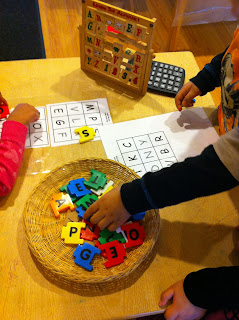
In the literacy area children have the opportunity to
develop literacy concepts such as language, phonemic awareness,
concepts of print, concepts of books, fine motor skills and alphabet knowledge. They explore emergent reading and writing activities. Listening and
thinking skills are enhanced, as they listen and tell and retell
stories.
 |
| Making a mail box |
 |
| Mailing letters |
 |
| Nature study |
Art
Art enhances children’s creative and literacy development by
allowing them to reflect and expand on stories, create their own stories, and
develop their creative and emotional expression in a safe and accepting
environment. This is an important part of learning how to express themselves
and to communicate. In the art area children are given the opportunities to
learn important art concepts and creativity, as well as to practice decision
making, learn about cause and effect, identify colors and shapes, texture,
design, refine hand-eye coordination, develop fine and gross motor skills,
express feelings, and practice sharing.
For young children, the process of creating is what is most
important, not what they actually create. Through their art, children express
how they feel, think, and view the world. Art is an outlet that allows children
to convey what they may not be able to say with words. Involvement with a rich
variety of art materials instills confidence. Art is enjoyable and satisfying
for young children. It enables them to learn many skills, express themselves,
appreciate beauty and have fun -- all at the same time.
 |
| Painting our bird feeder- team work |

 |
| This picture represents a whole story |
 |
| Exploring liquid water colours |
 |
| Practicing scissor skills |
 |
| Stamping zeros |
 |
| Patterns and sequencing |
Math, Puzzles, Games, &
Manipulatives
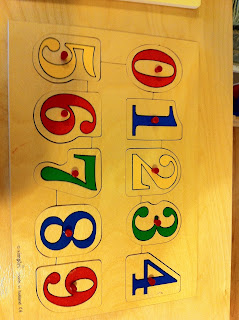
The Math and Number Concepts encourages exploration of concepts related to math, as well as, literacy. Children develop creative problem-solving, logical
thinking skills and practice emerging math skills such as sorting,
classification, counting, sequencing and matching. Physical development is enhanced as children
develop hand-eye coordination and fine muscle skills. Children learn to
work cooperatively in small groups playing simple table games and building
together. They begin to demonstrate perseverance and self-regulation, as well
as experiencing satisfaction in their accomplishments as they work at a task until it is
completed.
 |
| Exploring weight and colour matching |
 |
| Building with Bristol Blocks |
 |
| Fishing Game |
 |
| Puzzles |
 |
| Community helpers-Matching |
 |
| Fine motor skills and matching/sequencing |
 |
| Exploring fractions |
 Science & Discovery
This area provides materials for children to learn about the
world Allah has created, problem-solve, discover, explore, evaluate, and draw
conclusions, sequencing, classifying and recording. Children will be
able to work together to find out what it feels like to be a scientist. Literacy
skills are practiced as children observe, evaluate and reflect on different
science activities they are engaged in.
They make discoveries, practice making predictions and inferences, which
are critical in developing comprehension skills used in reading.
 |
| What can you see and discover? |
 |
| Discovery bottles |
 |
| Exploring Magnetism |
 |
| Exploring natural material |
 Blocks & Building
Children have the opportunity to develop many cognitive
skills as they experiment with the size, shape, color, number, and volume of
the materials in this area. They test physics principles when they build
skyscrapers and bridges carefully balancing each block they add to their
design. They practice social skills when they share, negotiate for materials,
and collaborate with other children. Symbolic thinking is developed as they
create models of architectural elements from their world. Vocabularies expand
and literacy learning is enhanced when children talk and draw about their
creations.
When children lift, shove, stack and move blocks, they learn
about weight and size. Discoveries about balance, sequence and gravity are
made. When playing with blocks, children gain many logical thinking skills,
including the ability to make use of classification and equivalence. Each time
they use blocks, they are expanding critical thinking by making decisions about
how to build a structure or solve a construction problem.
 |
| Working together to build the biggest train |
 Dramatic Play
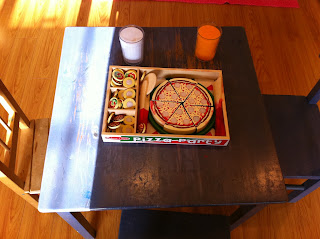
In the dramatic play area children take on a role and
recreate real-life experiences. They use props and make-believe about a wide
variety of topics. As children plan, implement, and construct their play
they have the opportunity to express their thoughts, feelings, and ideas with
language. Through the use of language they learn social skills, negotiating
skills, and conflict resolution techniques. They draw on past experiences
to try to solve problems and construct their understanding of new concepts.
The ability to pretend is very important to children's later
academic success. When children pretend, they have to recall experiences they
have had and re-create them. To do this, they have to be able to picture their
experiences in their minds. For example, to play the role of a doctor, children
have to remember what tools a doctor uses, how a doctor examines a patient, and
what a doctor says. In playing the role of doctor, children have to be able to
cooperate with other children and defend their own ideas.
As children act out roles, they develop many new skills.
They learn about themselves, their families and society. Engaging in dramatic
play, they learn to judge and select relevant information. This is an essential
skill for cognitive development. Children also learn from one another as they
interact in socio-dramatic play. They learn to ask and answer questions and to
work together to solve problems.
 |
| Doctors at work |
 Outdoors
Outdoor play is fun for children and important to
their growth and development. Opportunities to climb, jump, run, skip, hop,
throw, catch and ride provide children with healthy release of energy. Being outside allows
children to stretch their muscles, breathe in fresh air, take in sunshine, and
enjoy the freedom of space.
What goes on outdoors is much more than simply physical
activity. Children advance in all areas of development when they play outdoors.
The special qualities of the outdoor environment set the stage for unique
experiences. Science, for example, comes alive when nature is explored and
observed firsthand.
Social skills and language develop as children build castles
together in the sandbox or work together to carry a heavy pail full of sand or
water. Children also pull each other in the wagon and negotiate compromises
about the use of equipment.
 Sand & Water Table- Sensory
Children's explorations with sand and water help build
various skills. By sifting sand and pouring water, children improve their
physical dexterity. By joining others in blowing bubbles or making a sand
castle, they develop social skills. At the same time, they enhance their
cognitive skills as they explore why certain objects sink in water and others
float. As a liquid, water can be splashed, poured, frozen and
evaporated. As a solid, sand can be sifted, raked, shoveled and dumped. Play
with each substance can be used to foster children's
social-emotional, cognitive, and physical growth.
A child has a practical math lesson in fractions when
she pours a cup full of sand into a two-cup container. Her fine-motor
skills are also being developed as she washes a tea set or maneuvers a cup full
of sand into a sifter. Her eye-hand coordination is helped.
Sensory explorations encourage children to explore and learn
about cause and effect. (For example, what happens if I put a sponge in the
water? What happens if I then squeeze the sponge?).
 |
| Play dough is great for building fine motor skills |
 Group Time
Generally teachers begin this group time with a specific
topic for discussion. It may be a topic related to Islamic studies, a project
the class is working on, or it may focus on a specific skill. Teachers also include stories, creative movement, games, songs & rhymes. These activities promote language development, fine-motor skills, and coordination, as well as
self-esteem. Children learn to focus, work in a group, take-turns, share ideas
and feelings, new concepts and have fun.
 Library Area
When children
are read to regularly and encouraged to look through books on their own, to
listen to stories, and to make up their own stories, they begin to understand
that pictures have meaning and that words tell a story. Their language skills
grow through exposure to books with different words. Exposure to multi-cultural
and multi-generational books and stories help children to begin to
understand how people are different and that our differences make us each
special.
Exposure to books and storytelling helps children understand that their
feelings, fears, questions and problems are not unique to them- that people have these things in common. Acquiring a
love for books is one of the most powerful incentives for children to become
readers.
Snack
Snack, like other scheduled activities, are
exceptionally good learning times. Children can learn to say the appropriate
Dua’s, serve themselves, to eat with a group, and to try new foods. They will
learn to use utensils and napkins as their skills develop. They will also learn
by watching others which is one reason why it is valuable for teachers to sit
with children during meals.
By our
keeping health and safety as a primary concern, children learn to understand
and respect each others food allergies, as well as family preferences and
beliefs about foods. Children use
gatherings, such as snack as social times. Pleasant conversations at the table
create a comfortable atmosphere for children to feel a part of a group.
Children
can also feel useful and proud of being able to help with mealtimes by setting
up the table, sponging the table after eating, and throwing out their own
trash.


